


World AMR Awareness Week 2026 shines a spotlight on shared responsibility to prevent antimicrobial resistance
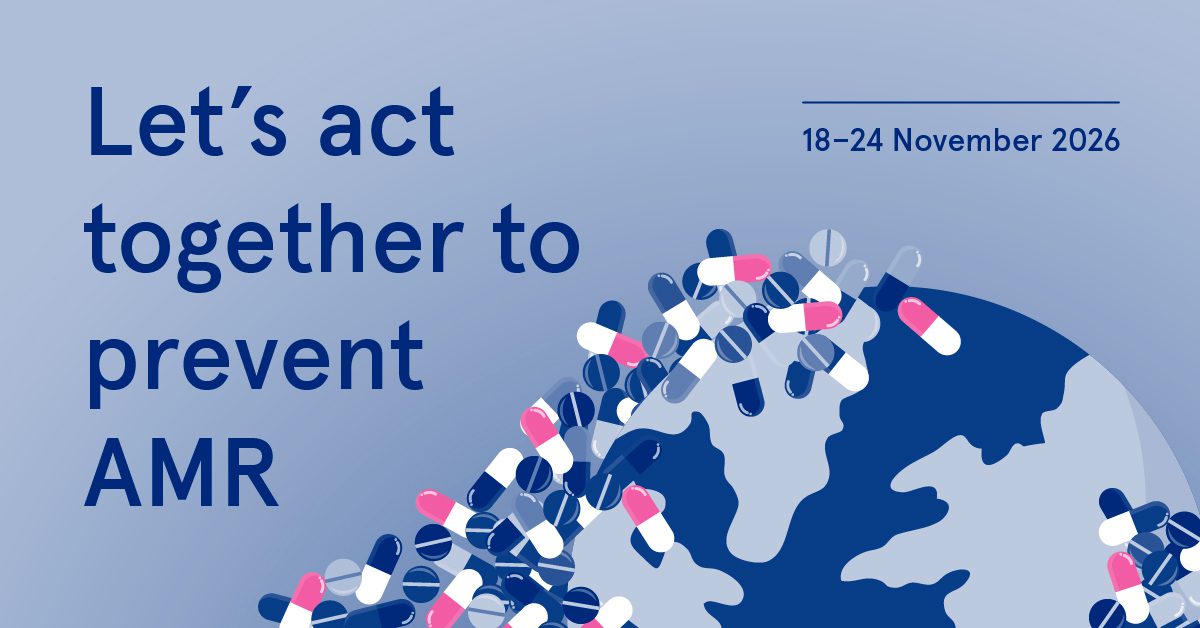
18-24 November marks World AMR Awareness Week (WAAW) – an annual global campaign to raise awareness and understanding of antimicrobial resistance (AMR) and to promote global action to tackle the emergence and spread of drug-resistant infections. The theme for WAAW 2026 is “One Health, one action: Prevent AMR now”.1
Aidian takes part in supporting antimicrobial stewardship and sustainable use of antibiotics in primary care.
Antimicrobial resistance is a major global health threat
Antimicrobial resistance (AMR) means the ability of micro-organisms, including bacteria, viruses, fungi, and parasites, to resist treatment. In most cases, AMR specifically concerns antibiotic resistance, which occurs when bacteria develop the ability to withstand the effects of antibiotics.
AMR, also known as the Silent Pandemic, is one of the top global public health and development threats. It has been ranked among the top three priority health threats by the European Commission and Member States, and the World Health Organization (WHO) has listed AMR among the top 10 global health threats facing humanity.2-4 In 2021, bacterial AMR was estimated to be associated with more than 4.7 million deaths globally.5 Without urgent action, AMR could cause up to 39 million deaths by 2050.1
WHO reinforces global action against antimicrobial resistance
According to WHO's Global Antibiotic Resistance Surveillance Report 2025, resistance to life-saving medicines is critically high and rising. The report states that in 2023, approximately one in six laboratory-confirmed bacterial infections worldwide were caused by bacteria resistant to antibiotics.6 WHO warns of widespread resistance to common antibiotics worldwide – especially drug-resistant Gram-negative bacteria are becoming more dangerous worldwide.7
When drug-resistant pathogens emerge and spread, they affect human health, animal health, food security, economies, and sustainable development. Their emergence and spread are also influenced by the health of our environment.1
In May 2026, WHO Member States adopted the updated Global action plan on antimicrobial resistance (GAP-AMR) 2026–2036, which is intended to serve as the global framework for coordinated action against AMR over the next decade. The adoption of the updated GAP-AMR reflects renewed global commitment to preserving the effectiveness of antimicrobials and safeguarding advances in human, animal and plant health, food security, economic development and environmental sustainability.8 The GAP-AMR calls on all countries and sectors to work together under a One Health approach to prevent and tackle AMR.1
The role of point-of-care testing in primary care
In healthcare, optimising antibiotic use is crucial to combating AMR: decreasing antibiotic overuse and providing antibiotics to those patients who benefit from the treatment.
Respiratory tract infections are the most common reason for antibiotic prescribing in primary care, even though the majority of infections have viral cause or are self-limiting.9 Fast, accurate, and easy-to-use point-of-care (POC) diagnostic tests play an important role in optimising antibiotic prescribing for respiratory tract infections in healthcare.
CRP testing is a key tool against antibiotic overuse
C-reactive protein (CRP) point-of-care testing (POCT) is recognised as an essential tool in healthcare to guide rational use of antibiotics and prevent the development of antibiotic resistance. CRP POCT has several benefits in management of patients with respiratory tract infections in primary care:
- provides immediate results for faster decisions
- increases diagnostic certainty for physicians
- targets antibiotic use for those patients who truly benefit from the treatment
- reduces antibiotic use by approximately 23% in acute respiratory tract infections10
Learn more about antimicrobial resistance and our QuikRead go CRP test portfolio.
References:
- World Health Organization (WHO). World AMR Awareness Week 2026: One Health, One Action: Prevent AMR Now. Available at https://www.who.int/news-room/events/detail/2026/11/18/default-calendar/world-amr-awareness-week-2026. Accessed 11.11.2026.
- European Commission. 'The silent pandemic': What is the EU doing to fight Antimicrobial Resistance? Available at: https://health.ec.europa.eu/publications/silent-pandemic-what-eu-doing-fight-antimicrobial-resistance_en. Accessed 11.11.2026.
- European Commission. EU Action on Antimicrobial Resistance. Available at https://health.ec.europa.eu/antimicrobial-resistance/eu-action-antimicrobial-resistance_en. Accessed 11.11.2026.
- World Health Organization (WHO). Ten threats to global health in 2019. Available at https://www.who.int/news-room/spotlight/ten-threats-to-global-health-in-2019. Accessed 11.11.2026.
- World Health Organization (WHO). Antimicrobial Resistance. Available at https://www.who.int/news-room/fact-sheets/detail/antimicrobial-resistance. Accessed 11.11.2026.
- World Health Organization (WHO). Global antibiotic resistance surveillance report 2025. Available at https://www.who.int/publications/i/item/9789240116337. Accessed 11.11.2026.
- World Health Organization (WHO). WHO warns of widespread resistance to common antibiotics worldwide. Available at https://www.who.int/news/item/13-10-2025-who-warns-of-widespread-resistance-to-common-antibiotics-worldwide. Accessed 11.11.2026.
- World Health Organization (WHO). The World Health Assembly adopts updated Global Action Plan on Antimicrobial Resistance (2026–2036). Available at https://www.who.int/news/item/25-05-2026-the-world-health-assembly-adopts-updated-global-action-plan-on-antimicrobial-resistance-(2026-2036). Accessed 11.11.2026.
- Bjerrum L et al. Health Alliance for Prudent Prescribing, Yield and Use of Antimicrobial Drugs in the Treatment of Respiratory Tract Infections (HAPPY AUDIT). BMC Fam Pract 2010; 11:29.
- Smedemark et al. Biomarkers as point-of-care tests to guide prescription of antibiotics in people with acute respiratory infections in primary care. Cochrane Database of Systematic Reviews 2022; 10: CD010130.